Under Capitalism, There’s No Such Thing as a “Fair Day’s Wage for a Fair Day’s Work”
We’ve got some bad news for you on Labor Day: your boss is exploiting you. Karl Marx explains how.
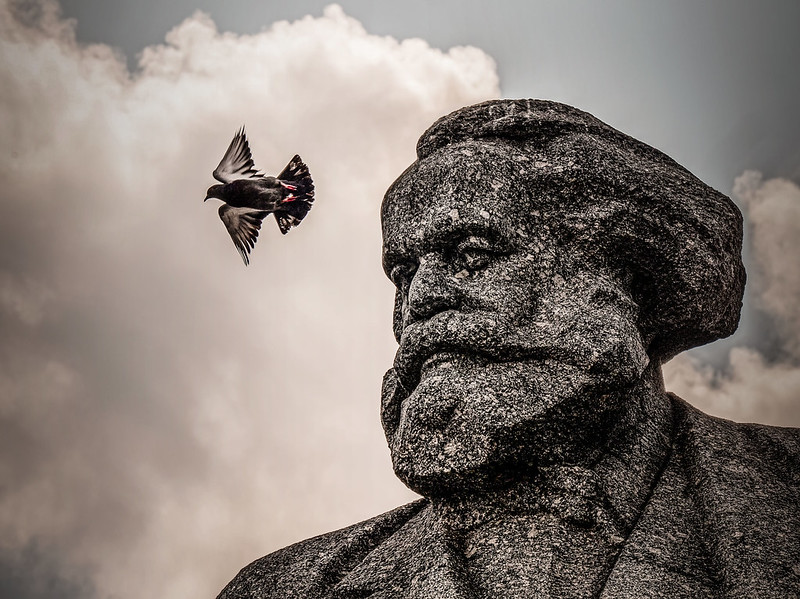
Monument to Karl Marx outside Bolshoi Theater in Moscow, 2019. (TxeTxu / Flickr)
Modern capitalism is characterized by an immense expansion of wealth. Its entire history is marked by growth. The US economy, when healthy, grows by about 4 percent per year. The Chinese economy, until recently, was growing by as much as 10 percent per year. And the world economy as a whole has expanded by roughly 3 percent annually since 1980, according to data from the World Bank. In fact, if any country’s output stops expanding, it goes into recession. If economies throughout the world contract all at once — as we’re seeing today — the result may well be a global depression.
How do capitalists generate this expanding surplus? Karl Marx, though he was writing 150 years ago, made an indispensable contribution to uncovering the internal laws of capitalism beneath the façade of equity. A useful starting point is to look at what Marx calls the “the general formula of capital,” which he summarized with a simple formula: M-C-M’.